 Gods / Goddesses / Deities
An / Anu – Aššur (Assur / Ashur) – Dagan – Enki / Ea – Enlil – Gula / Ninisina – god lists – Inana / Ištar(Ishtar) – Iškur / Adad – Ištaran – Marduk – Martu / Amurru – Nabu – Nammu – Nanna / Suen / Sin – Nergal / Erra – Ninurta – the Seven Gods – Utu / Šamaš (Shamash) –
Demons, Powers and Spirits
Lamaštu – lion men / demons – Pazuzu
Cosmology
Abzu – underworld
Cult and Ritual
bucket and cone / cone-smearing – kudurru – magic – names (theophoric) – New Year festival – sacred marriage– ziggurat
Iconography
arrow – chaplet (beads) – crescent (moon) – horned cap – solar disc – winged disc –
Mythology
Acknowledgements
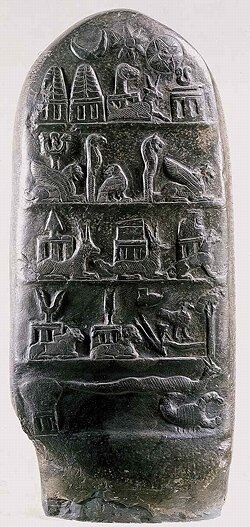
(image) a kudurru of Melishihu, now in the Musée du Louvre, Paris: taken from Babylonia to Susa. Kassite period (1202-1188 BC). Grey limestone, height 0.65 m, width 0.30 m.
The Kassite kings of Babylon made generous gifts to their vassals. Record of these was kept on boundary posts, or kudurru, of lands that had been gifted, as well as on great standing stones kept in the temples. These donation lists were placed under the protection of the greatest possible number of gods, usually represented in their symbolic form and arranged according to the hierarchy of the pantheon. In this case, however, the uppermost symbols of those of the 3 heavenly gods: Sin (moon), Shamash (sun) and Ishtar (Venus), in order of their position in the heavens, rather than their importance. They were surpassed by the supreme triad: Anu (sky), Enlil (air) symbolized by their horned crowns and Ea (fresh water from the abyss), symbolised by a sceptre carried by a goat-fish. Below are found the emblems of other gods: that of Marduk, patron-god of Babylon, is identifiable as a pointed hoe placed on a stand and the serpent-dragon which guards the underworld. The same dragon carries the scribe’s stylus, the emblem of Nabu, Marduk’s son. (larger image).
Acknowledgements: Peter Westh, Piotr Steinkeller